

click here to return to the list of choices
How loud will an AI data center actually be?
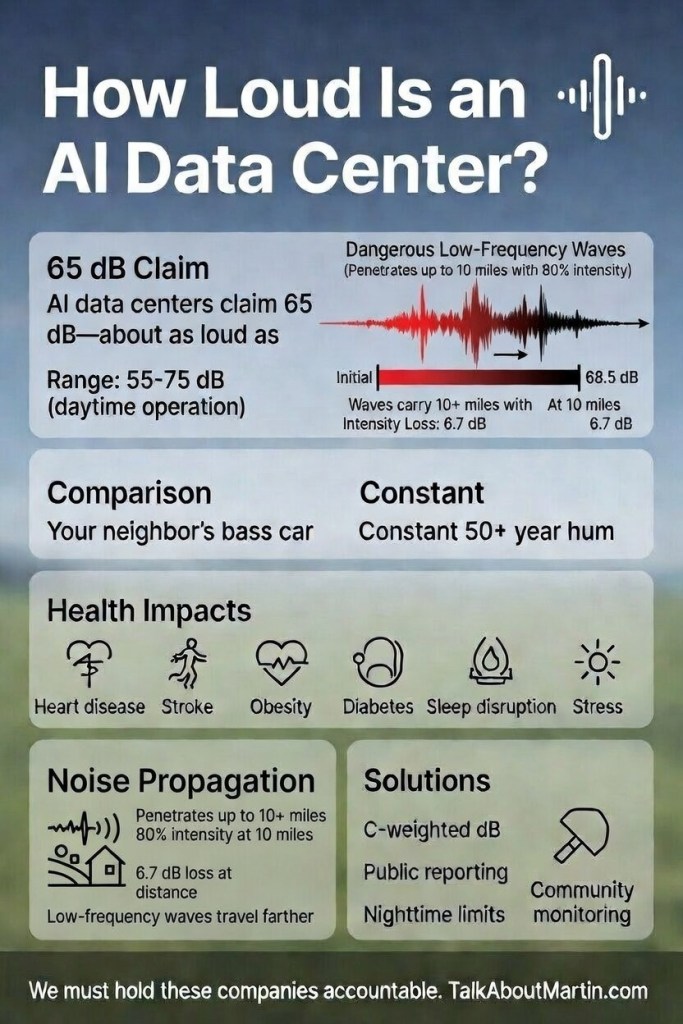
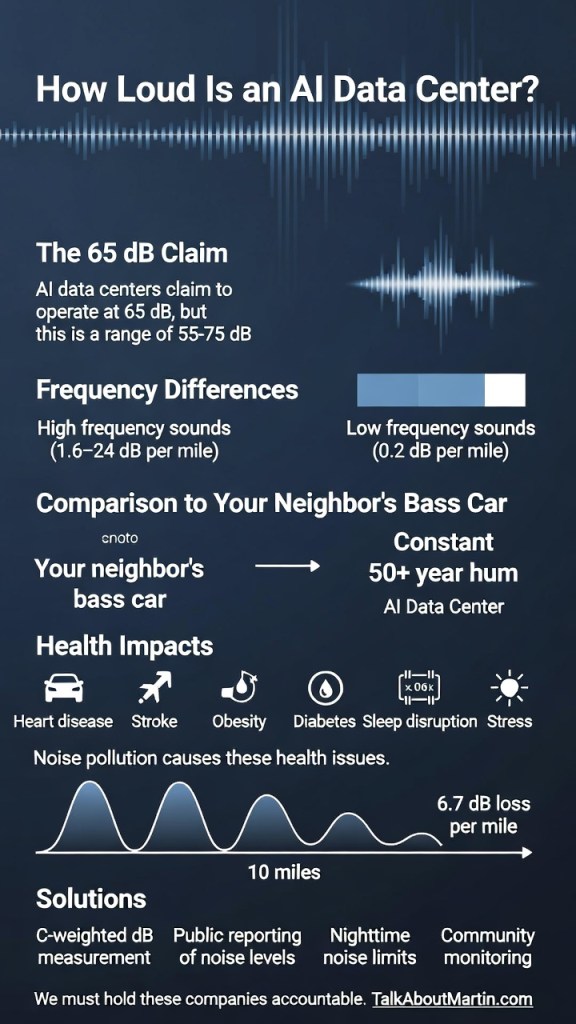
The short answer, 65 dB at the property line. What does that actually mean?
Let’s think about frequencies here. When we have a high frequency, it’s going to be very easily blocked. 1.6 to 24 decibel reduction per mile. That means the sound goes down the further away you are from it. That’s awesome. But we know with low frequencies, these are longer frequencies.
These are wavelengths that are tens, 20, maybe even 100 ft long. If we think about the reduction over time, this is about 0.2 dB a mile. It would take a long distance before you wouldn’t hear it any longer. Let’s compare this to your own lived reality. We got your neighbor’s bass car, the guy who always wakes you up in the morning versus a data center for AI.
Now, your neighbor is a temporary annoyance. They’re going to go somewhere else. They’re always on the run. They got to be doing other stuff and their bass is going to go with them. A data center is a long-term annoyance. Currently, we’re looking at like a 50-year timeline, maybe even longer for these data centers to exist.
With your neighbor, we have a thump. With data centers, we have a hum, a constant, sometimes fluctuating. Let’s look at how much they make. On average, somebody in Indiantown is making about $34,000 a year. AI Data Center by Google. The company is worth $3.4 trillion dollar. Do you think that one of these people is in a better position to solve the problem of noise than the other one?
An increase in noise leads to an increase in heart disease and stroke. Also, obesity and diabetes. This also increases sleep disruption. All these things kind of follow from this too. And increases your stress and anxiety. We see the sleep disruption especially in children. So if you have small kids who are more sensitive to sound, they will be woken up more often, which means you’re going to be woken up more often and going to have less sleep and maybe some of these other issues.
But how do we actually fix this issue? We create good rules and laws for people like Google to follow. We can use something like a stronger-weighted decibel rating to get a more accurate representation of all of the frequencies, not just the frequencies that are more specific to the human hearing.
We can also require public noise reporting. This would be a website that shows how many decibels are actually getting out into the environment so we can understand where the noise is coming from. If we limit the amount of noise coming out at night, we may increase some of the sleep that the neighbors feel and your kids are going to sleep better, which is awesome. We need community noise monitoring. We need decibel meters that aren’t just on the property lines of these data centers, but throughout the community to understand the real impact. So, I hope that answers your question of how loud the data center will be. Can’t wait to talk to you later.
 Talk About Martin