
3 March 2026

Data centers generate noise (sound), low-frequency noise or infrasound (often perceived as vibrations), and artificial light pollution from 24/7 operations, primarily HVAC/cooling systems, servers, backup generators, and security/operational lighting. These can affect nearby residents (sometimes at distances of 0.5–2.5 miles), though effects vary by distance, topography, individual sensitivity, and facility design. Evidence comes from general environmental health research on noise and light pollution (strong and well-established), specific resident complaints and modeling near data centers, and emerging measurements—especially as AI-driven expansion increases facility size and density.
THE CIRCLE ON THE MAP REPRESENTS APPROX. 2.5 MILES FROM THE CENTER OF THE PROPOSED SILVER FOX 606 PROJECT.
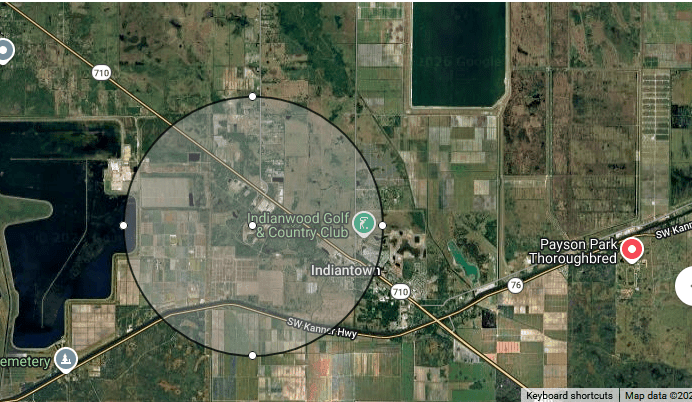
IS YOUR PROPERTY IN THE DANGER ZONE?
Sound (Noise Pollution)
Sources: Large HVAC fans, chillers, diesel generators, and server cooling create a constant audible hum or drone (often described as an “airplane” or “helicopter” sound). Internal levels reach 80–96 dBA; external residential exposure can exceed 50–60+ dBA with intrusive tonal elements.
Potential health effects (supported by WHO, meta-analyses, and epidemiological studies):
- Sleep disturbance and insomnia — Nighttime noise disrupts deep sleep stages, causing frequent awakenings and daytime fatigue.
- Chronic stress and annoyance — Triggers cortisol release and autonomic nervous system activation (even if “tuned out”), leading to anxiety, irritability, and reduced quality of life.
- Cardiovascular risks — Long-term exposure raises blood pressure, hypertension, heart attack, stroke, and other heart disease risks (noise ranks second only to air pollution as an environmental health hazard in Europe).
- Hearing damage — Prolonged levels above 85 dBA can cause permanent loss or tinnitus (more relevant for workers inside facilities).
- Cognitive and other effects — Impaired concentration, learning difficulties (especially in children), headaches, and reduced productivity.
Low-frequency components (see below) make the noise particularly hard to block or ignore, as it penetrates buildings more effectively than higher frequencies.
Real-world examples include widespread complaints near facilities in Virginia (“Data Center Alley”), Chicago, Arizona, and Texas (similar bitcoin mining sites), with residents reporting the hum affecting sleep and daily life.
Low-Frequency Vibrations and Infrasound
Sources and nature: HVAC systems, large fans, and generators produce low-frequency noise (LFN, typically 20–200 Hz) or infrasound (<20 Hz). This is often inaudible or barely audible but felt as pressure, rumbling, window rattling, or whole-body vibrations. It travels farther than higher-frequency sound and is difficult to mitigate with standard barriers. Measurements near some sites show elevated levels (e.g., 10 dB higher infrasound than background at hundreds of feet, with perceptible effects at 0.75–1 mile).
Note: These are primarily airborne acoustic phenomena (sound waves causing perceived vibration), not strong ground-borne structural vibrations from the facility itself. Data centers actually design against external vibrations to protect equipment.
Potential health effects (from systematic reviews of LFN/infrasound and resident reports):
- Annoyance, sleep issues, and fatigue — The brain struggles to filter LFN, leading to irritability, morning tiredness, and chronic sleep disruption.
- Vestibular and sensory symptoms — Dizziness, vertigo, nausea, ear pressure, or motion-sickness-like feelings (linked to vestibular system disruption).
- Stress-related and cognitive — Headaches, concentration difficulties, anxiety, and elevated cortisol; some studies link prolonged exposure to reduced mental performance.
- Cardiovascular and other — Possible heart strain or blood vessel changes (e.g., vibroacoustic disease at very high levels); overlaps with general noise effects like hypertension.
A 2020 meta-review of LFN studies found the most common impacts were annoyance (13%), sleep disorders (12%), cardiovascular changes (10%), and hearing effects (8%). Effects are dose-dependent (worse closer to the source) and can persist or sensitize some people. Resident reports near data centers or similar facilities include migraines, vertigo, and “felt” rumbling; one independent measurement project correlated infrasound spikes with community symptoms via controlled experiments.
Light Pollution (Artificial Light at Night)
Sources: Round-the-clock security, building, and parking lot lighting on large campuses (hundreds of acres) creates constant glow, skyglow, and light trespass into neighboring areas—especially noticeable in rural or suburban settings.
Potential health effects (from artificial light at night / ALAN research):
- Circadian disruption and sleep problems — Suppresses melatonin production, shifting sleep-wake cycles and causing insomnia or poor sleep quality.
- Metabolic and mental health — Associated with increased risks of obesity, type 2 diabetes, hypertension, anxiety, depression, and mood disorders.
- Other links — Observational data tie chronic nighttime light exposure to higher breast/prostate cancer risk (via melatonin/estrogen pathways) and broader cardiovascular issues. Shift-work studies (classified as probable carcinogen) provide mechanistic support.
Data centers add to “fenceline” community exposure; combined with noise, this compounds stress and sleep loss.
Overall Context and Caveats
- Cumulative impacts: Noise + light + vibrations often worsen each other through chronic stress and sleep loss. Vulnerable groups (children, elderly, those with preexisting conditions) are more affected.
- Evidence strength: Very strong for audible noise and general light pollution health pathways (decades of studies). LFN/infrasound effects are well-documented for annoyance/sleep but more observational for direct physiological harm at typical environmental levels (debate continues). Data-center-specific research is growing but relies heavily on modeling, complaints, and applied science rather than large randomized trials.
- Mitigation options: Zoning setbacks, acoustic barriers/silencers, vibration isolation, liquid cooling (quieter), shielded/full-cutoff lighting, and nighttime curfews. Some localities are updating ordinances.
- Public health scale: Projections for U.S. data center growth (driven by AI) highlight broader burdens, though air pollution from backup power is often the larger modeled risk (not covered in your query).
Here are your sources
Data Center–Specific Studies & Reports
- Gour, N., Ortiz, L., & Maibach, E. (2026). Health implications of the rapid rise of data centers in Virginia: an exploratory assessment. Frontiers in Climate, 8, Article 1648912. Link:https://www.frontiersin.org/journals/climate/articles/10.3389/fclim.2026.1648912/fullRecap: First dedicated assessment of Virginia’s “Data Center Alley” linking persistent noise from cooling systems/generators (40–59 dB) to sleep disturbance, annoyance, cardiovascular risks, cognitive/mental health issues, and child learning deficits; calls for better zoning and acoustic mitigation.
- Lyver, J. W. (2022). Data center noise study for Prince William, Fauquier, and King George Counties and the Town of Warrenton [Technical report]. Link:https://protectpwc.org/wp-content/uploads/2023/02/Lyver-Data-Center-Noise-Study-123122.pdfRecap: Independent modeling predicts low-frequency HVAC/generator noise exceeding local ordinances up to 2.5 miles, causing school disruptions, chronic stress, and sleep issues; highlights inadequacy of standard barriers for low frequencies.
Low-Frequency Noise & Infrasound Reviews
- Araújo Alves, J., Paiva, F. N., Silva, L. T., & Remoaldo, P. (2020). Low-frequency noise and its main effects on human health—A review of the literature between 2016 and 2019. Applied Sciences, 10(15), Article 5205. Link:https://doi.org/10.3390/app10155205Recap: Review of 142 studies shows low-frequency noise (<200 Hz) and infrasound as chronic stressors leading to sleep disorders, annoyance, hearing changes, and cardiovascular effects; relevant to industrial HVAC sources like data centers.
General Noise Health Impacts (Applicable to 24/7 Data Center Operations)
- Smith, M. G., Cordoza, M., & Basner, M. (2022). Environmental noise and effects on sleep: An update to the WHO systematic review and meta-analysis. International Journal of Environmental Research and Public Health, 19(14), Article 8497. Link:https://www.ncbi.nlm.nih.gov/pmc/articles/PMC9272916/Recap: Meta-analysis confirms nighttime noise (even ~40 dB) disrupts sleep and raises cardiovascular risks; directly applicable to constant data-center hum.
- Münzel, T., Gori, T., Babisch, W., & Basner, M. (2014). Cardiovascular effects of environmental noise exposure. European Heart Journal, 35(13), 829–836. Link:https://doi.org/10.1093/eurheartj/ehu030 (open access: https://pmc.ncbi.nlm.nih.gov/articles/PMC3971384/) Recap: Review links chronic noise to hypertension, heart attack, and stroke via stress hormones and autonomic effects; nighttime exposure is particularly harmful for persistent sources.
Artificial Light at Night (ALAN) & Light Pollution
- Jiménez, D., Neira Arenas, L., Hernández Rincón, E. H., García Céspedes, M. J., & Jaimes Peñuela, C. L. (2025). Luminous threats: The health impacts of artificial nighttime light on metabolic and mental health: A scoping review. Current Research in Environmental Health Reports. Link:https://doi.org/10.1016/j.crh.2025.100026 (full article: https://www.sciencedirect.com/science/article/pii/S2666558125000260) Recap: Scoping review of 32 studies ties constant ALAN (e.g., from data-center lighting) to melatonin suppression, obesity, diabetes, hypertension, depression, anxiety, and possible cancer risks.
Authoritative Guidelines & Broader Context
- World Health Organization. (2018). Environmental noise guidelines for the European Region. Link:https://www.who.int/publications/i/item/9789289053563 (full PDF: https://iris.who.int/bitstream/handle/10665/279952/9789289053563-eng.pdf) Recap: Evidence-based limits recommend nighttime noise ≤40–45 dB to prevent cardiovascular, sleep, and cognitive harm; noise ranks as a major environmental health risk in Europe.
These form the core scholarly and technical backbone
 Talk About Martin
3 thoughts on “dATACENTER Health Issues including Sound !”