

RE: Opposition to Silver Fox 606 (2.2 Million sq ft Air-Cooled Hyperscale AI Data Center) Proposal – Significant Gaps, Procedural Deficiencies, and Inconsistency with Indiantown’s Comprehensive Plan and Land Development Regulations
Dear Village Council Members,
I write as a concerned resident of Martin County, Florida, to share detailed observations and concerns about the Village’s consideration of the Silver Fox 606 hyperscale AI data center proposal (the “AI Data Center”). This 2.2 million sq ft air-cooled facility on approximately 200+ acres at 13820 Silver Fox Road represents an unprecedented industrial-scale development in our region.
I am greatly concerned that the significant gaps in information about the facility will affect the Village’s consideration of its impacts. The Village should ensure its citizens are afforded their procedural due process rights. The AI Data Center is inconsistent with the Village’s Local Land Use Laws because it will fundamentally and forever change the character of Indiantown, overwhelm existing facilities, is incompatible with the classification of an industrial use under current LDR standards, and will likely result in significant adverse impacts to the community and the environment.
LEGAL FRAMEWORK
I. The Statutory Mandate to Adopt Comprehensive Plans and Deny Development Orders Which Violate Them
The Community Planning Act requires all local governments to adopt and maintain a comprehensive plan which guides future land development. Fla. Stat. § 163.3167(1)(b), (2). Under the Act, “no public or private development shall be permitted except in conformity with comprehensive plans, or elements or portions thereof.” Id. § 163.3161(6). The Act strictly prohibits the approval of a development order that is inconsistent with an adopted Comprehensive Plan. Id. §§ 163.3161(5), 163.3194(1) & (3), 163.3215; Pinecrest Lakes v. Shidel, 795 So.2d 191 (Fla. 4th DCA 2001) review denied, 821 So. 2d. 300 (Fla. 2002). The statute states that:
After a comprehensive plan, or element or portion thereof, has been adopted …, all development undertaken by, and all actions taken in regard to development orders … in regard to land covered by such plan or element shall be consistent with such plan or element as adopted.
Fla. Stat. § 163.3194(1)(a).
A “development order” is “any order granting, denying, or granting with conditions an application for a development permit.” Id. § 163.3164(15). A “development permit” means “any building permit, zoning permit, subdivision approval, rezoning, certification, special exception, variance, or any other official action of local government having the effect of permitting the development of land.” Id. § 163.3164(16).
Section 163.3194(3) defines what it means for a development order to be consistent with a comprehensive plan:
(a) A development order …shall be consistent with the comprehensive plan if the land uses, densities or intensities, and other aspects of development permitted … are compatible with and further the objectives, policies, land uses, and densities or intensities in the … plan and if it meets all other criteria enumerated by the local government.
(b) A development approved … shall be consistent with the comprehensive plan if the land uses, densities or intensities, capacity or size, timing, and other aspects of the development are compatible with and further the objectives, policies, land uses, and densities or intensities in the … plan and if it meets all other criteria enumerated by the local government.
Id. § 163.3194(3) (emphasis added).
“The comprehensive plan is similar to a constitution for all future development within the governmental boundary.” Citrus Cty. v. Halls River Dev., Inc., 8 So.3d 413, 420–21 (Fla. 5th DCA 2009); Machado v. Musgrove, 519 So.2d 629, 631 (Fla. 3d DCA 1987) (“A comprehensive plan is … a constitution for all future development ….”). The emphasis placed by Florida law on the prohibition against the issuance of a development order that violates a comprehensive plan is also highlighted by the fact that the Legislature enacted Section 163.3215(3) to create a specific legal mechanism for enforcement of the consistency requirement by authorizing legal review in a de novo action … against any local government to challenge any … development order…, which materially alters the use or density or intensity of use on a particular piece of property which is not consistent with the comprehensive plan ….”
Fla. Stat. § 163.3215(3) (emphasis added).
This statutory cause of action authorizes any aggrieved person to challenge the validity of development orders that are not consistent with comprehensive plans:
“Any aggrieved or adversely affected party may maintain a de novo action for declaratory, injunctive, or other relief against any local government to challenge any decision of such local government granting or denying an application for, or to prevent such local government from taking any action on, a development order … which materially alters the use or density or intensity of use on a particular piece of property which is not consistent with the comprehensive plan adopted under this part.”
§ 163.3215 (3), Fla. Stat.
The Florida Supreme Court has recognized the clear Legislative prohibition on the approval of development orders that do not comply with comprehensive plans by establishing “strict scrutiny” as the standard of judicial review of development orders. “Strict scrutiny” requires a strict showing of comprehensive plan consistency, under which a court engages in a detailed examination of the order for exact compliance. The applicant for a development order bears the burden of proving that it conforms strictly to the comprehensive plan. Snyder v. Board of County Commissioners of Brevard County, 627 So. 2d 469 (Fla. 1993); United States Sugar Corp. v. 1000 Friends of Fla., 134 So. 3d 1052 (Fla. 4th DCA 2013); Village of Key Biscayne v. Dade County, 627 So.2d 1180 (Fla. 3d DCA 1993).
For example, in Pinecrest Lakes, Inc. v. Shidel, 795 So. 2d 191 (Fla. 4th DCA 2001), the Fourth District upheld a trial judge’s order requiring the demolition of multiple apartment buildings that had been built in violation of Martin County’s Comprehensive Plan. In sum, a local government is required to enforce its comprehensive plan, unless and until it is formally amended. Baker v. Metropolitan Dade County, 774 So. 2d 14 (Fla. 3d DCA 2000).
II. A Village Council Must Deny Development Applications that Violate its Land Development Code.
Once a comprehensive plan is adopted, all land development regulations (such as zoning codes) must also be consistent with the plan. Fla. Stat. §§163.3201, 163.3213. In turn, local governments are required to deny development orders that violate their land development regulations. Broward County v. G.B.V. Int’l, Ltd., 787 So. 2d 838, 843 (Fla. 2001). The burden of proving that a project meets the criteria is on the applicant. Brevard County v. Snyder, 627 So.2d 469 (Fla. 1993); Conetta v. City of Sarasota, 400 So.2d 1051 (Fla. 2d DCA 1981).
A local government’s approval of a development order that violates a local ordinance constitutes the failure to apply the correct law, which a court will reverse upon review. Town of Juno Beach v. McLeod, 832 So.2d 864, 867 (Fla. 4th DCA 2002); City of Ocala v. Green, 988 So 2d 114, 116 (Fla 5th DCA 2008); Broward County v. G.B.V. Int’l, Ltd., 787 So.2d 838 (Fla. 2001); Miami-Dade County v. Omnipoint Holdings, 863 So.2d 195 (Fla. 2003); Baker v. Metropolitan Dade County, 774 So.2d 14, 19-20 nn. 12-14 (Fla. 3d DCA 2001), rev. denied, 791 So.2d 1099 (2001).
III. When a Local Government’s Denial of an Application is Challenged, the Courts Defer to the Local Government’s Judgment.
Zoning resolutions are presumed valid and should not be interfered with by the courts unless they are arbitrarily and unreasonably applied to a particular piece of property. See, e.g., Eastside Properties, Inc. v. Dade County, 358 So.2d 873 Fla. 3d DCA 1978; and Smith v. City of Miami Beach, 213 So.2d 281 (Fla. 3d DCA 1968). Land use regulations are presumed to be valid by the courts and “take” private property rights only where a plaintiff bears the burden of proving that they either (1) do not advance a legitimate governmental interest or (2) deny the landowner all or virtually all economically viable use of his or her land. Agins v. City of Tiburon, 447 U.S. 255 (1980); Penn Central Transp. Co. v. New York City, 438 U.S. 104 (1978).
Next, when a decision involves technical or scientific expertise, a court will defer to any reasonable agency decision. Ocean Advocates v. U.S. Army Corps of Engrs., 361 F.3d 1108, 1119 (9th Cir. 2004); Lands Council v. McNair, 537 F.3d 981, 983 (9th Cir. 2008); Marsh v. Oregon Nat. Res. Council, 490 U.S. 360, 377, 109 S. Ct. 1851, 104 L. Ed. 2d 377 (1989); Baltimore Gas & Elec. Co. v. NRDC, Inc., 462 U.S. 87, 103, 103 S. Ct. 2246, 76 L. Ed. 2d 437 (1983). These cases explain that scientific conclusions are, by their nature, subject to uncertainty and controversy and debate amongst experts.
A court will not overturn an agency’s decision simply because a permit applicant presented evidence and opinion that conflicted with that upon which the agency relied in making its decision. In Ecology Center v. Castaneda, 574 F.3d 652 (9th Cir. 2009), the court upheld the U.S. Forest Service’s approval of timber sales and restoration projects in a National Forest against a challenge from environmental interests. Id. at 659–60. Upholding the agency action under the Federal Administrative Procedure Act’s “arbitrary and capricious” standard, the court ruled that it should grant “considerable discretion to agencies on matters ‘requir[ing] a high level of technical expertise.’” Id. at 658–59. Addressing the issue of competing scientific positions head-on, the court found that “[t]hough a party may cite studies that support a conclusion different from the one the [agency] reached, it is not [a court’s] role to weigh competing scientific analyses.” Id at 659 (citing Lands Council v. McNair, 537 F.3d 981, 988 (9th Cir. 2008) (noting it is not the proper role of the court to “act as a panel of scientists that instructs the [agency how to] choose[] among scientific studies”). Short of proving that the agency’s “analysis is outdated or flawed,” the Plaintiffs could not meet their burden by relying on other science that suggested a different scientific determination than was made by the agency. Id. at 659-60.
Florida law gives particular deference to government decisions involving disputed scientific determinations. See, e.g., Haire v. Fla. Dep’t of Agric. & Consumer Servs., 870 So. 2d 774, 786 (Fla. 2004); Island Harbor Beach Club, Ltd. v. Dep’t of Natural Ress., 495 So. 2d 209 (Fla. 1st DCA 1986). This judicial deference to agency decisions in the face of disputed expert opinions or conclusions has been consistently applied to the decisions of Florida local governments concerning development requests under its zoning code. A local government’s denial of a development permit that is based on any valid, sound scientific, engineering, planning, or other competent, relevant evidence cannot be overturned by a court on the basis that the applicant presented evidence to the contrary. St. Johns County v. Smith, 766 So. 2d 1097 (Fla. 5th DCA 2000); Haines City Community Dev. v. Heggs, 658 So. 2d 523, 530 (Fla. 1995) (“the circuit court functions as an appellate court and … is not entitled to reweigh the evidence or substitute its judgment for that of the agency.”); G.B.V. Int’l, Ltd., 787 So. 2d 838, 846 n. 25 (Fla. 2001) (“[T]he [circuit] court cannot reweigh the evidence.”); Orange County v. Butler, 877 So. 2d 810, 813 (Fla. 5th DCA 2004) (“A local government’s quasi-judicial decision must be upheld if there is any competent, substantial evidence supporting it.”). See also Osceola Fruit Distrib. v. Mayo, 115 So. 2d 760, 761 (Fla. 2nd DCA 1959).
A circuit court is not allowed to conduct its “own de novo review of the application and, based on the cold record, substitute[] [its] judgment for that of the Commission as to the relative weight of the conflicting testimony.” Fla. Power & Light Co. v. City of Dania, 761 So. 2d 1089, 1093 (Fla. 2000). If it were to do so, “[t]he circuit court . . . [would] usurp[] the fact-finding authority of the agency.” Id. A reviewing court “must defer to the local government’s superior technical expertise and special vantage point in such matters.” Dusseau v. Metro. Dade County Bd. of County Com’rs, 794 So. 2d 1270, 1275-76 (Fla. 2001). Put another way, “[w]hen the facts are such as to give an agency the choice between alternatives, it is up to that agency to make the choice, not the circuit court.” Miami-Dade Cty. v. Reyes, 772 So. 2d 24, 28 (Fla. 3d DCA 2000).
The opinions, analyses, and recommendations presented by professional planning experts at local commission meetings constitute competent substantial evidence that will preclude a court from overturning the agency’s decision. Hillsborough County Board of County Commissioners v. Longo, 505 So. 2d 470 (Fla. 2d DCA 1987). Fact-based testimony in a public zoning hearing before a county commission also constitutes competent substantial evidence which cannot be rejected or ignored by a reviewing court. Marion County v. Priest, 786 So. 2d 623 (Fla. 5th DCA 2001), review denied, 807 So. 2d 655 (Fla. 2002). An environmental expert’s testimony, reports, and site maps presented at county commission hearing constitute competent substantial evidence that will support the local decision if challenged in court. Miami-Dade County v. Walberg, 739 So. 2d 115 (Fla. 3d DCA 1999).
Next, as to disputed interpretations of its zoning regulations, a local government’s interpretation and application of its codes will not be overruled by a court unless it is clearly erroneous. Las Olas Tower v. City of Ft. Lauderdale, 742 So. 2d 308 (Fla. 4th DCA 1999).
It is thus clear that the Village of Indiantown may and must deny an application for a development permit if there is any valid basis to conclude that its approval fails to satisfy its zoning regulations. The analysis below of the relevant regulations that govern applications for industrial-scale development under Indiantown’s LDR include many requirements that applicants must meet to qualify for approval to construct a massive hyperscale AI data center—a substantial number of which are stated as narrative standards that require the exercise of professional judgment of experts—just the kind of decision to which courts will defer upon a legal challenge.
IV. The Harris Act Applies Only in Rare Cases.
Since its enactment in 1995, Florida’s Harris Act has been mentioned frequently by lawyers for landowners and even some local officials as an impediment to the enforcement of local regulation. That claim relies on the fact that the Harris Act “provides a cause of action for governmental actions that may not rise to the level of a taking under the State Constitution or the United States Constitution.” Fla. Stat. § 70.001(9). But the Act only applies to new regulations enacted after its adoption in 1995, and establishes a high bar for the granting of compensation, which is required only in the rare cases where regulations subject to the Act “inordinately burden” an individual property owner. The Act entitles landowners to compensation only where they can prove that a regulation “has inordinately burdened an existing use of real property or a vested right to a specific use of real property.” Id. §70.001(2). Not just any burden requires compensation. It must be an “inordinate burden.”
The terms “inordinate burden” and “inordinately burdened” mean, an action … [which] has directly restricted or limited the use of real property such that the property owner is permanently unable to attain the reasonable, investment-backed expectation for the existing use of the real property or a vested right to a specific use of the real property with respect to the real property as a whole, or that the property owner is left with existing or vested uses that are unreasonable such that the property owner bears permanently a disproportionate share of a burden imposed for the good of the public, which in fairness should be borne by the public at large.
Id. § 70.001(3)(e)(1) (emphasis added).
Florida appellate courts have only confirmed one Harris Act violation, but have overturned several lower court rulings that the Act had been violated. Town of Ponce Inlet v. Pacetta, LLC, et al, 120 So. 3d 27 (Fla. 5th DCA 2013). See also M&H Profit, Inc. v. Panama City, 28 So.3d 71(Fla. 1st DCA 2009); Holmes v. Marion County, 960 So.2d 828 (Fla. 5th DCA 2007); Jacksonville v. Coffield, 18 So.3d. 589 (Fla. 1st DCA 2009). The lone case where an appeals court found a violation involved an unusual set of facts—a set of actions by the local government that clearly trampled on a landowner’s vested rights. Ocean Concrete, Inc. v. Indian River Cty., Bd. of Cty. Comm’rs, 241 So. 3d 181, 183 (Fla. 4th DCA 2018).
A local government’s denial of this proposed hyperscale AI data center, based on sound conclusions that the land or operation are unsuitable based on duly adopted, long-standing governing legal standards, leaving the applicant the ability to continue to engage in the land’s historic uses—consistent with those of neighboring landowners—is not likely to result in a Harris Act violation.
I hope that the analysis allows the Village to proceed with the confidence that, absent making a wholly arbitrary decision, it is well within its legal rights and responsibilities to strictly enforce the standards in its comprehensive plan and regulations and deny development applications that fail to meet those standards.
SUBSTANTIVE ARGUMENTS AND EVIDENCE
I. Given the Significant Gaps of Information, Approval Would Be Premature.
As it currently stands, there are significant gaps in knowledge about the design and implementation of the AI Data Center. The Village should take its time and look before it leaps into an entirely new frontier. The developer—which has not constructed an AI data center of this scale to the operation stage—is proposing a brand new (and untested) configuration for a hyperscale AI data center. But Indiantown is not an experiment.
The Village is tasked with considering proximity to wetlands, nature of vegetation, site-specific and off-site environmental characteristics and impacts, and other appropriate matters of impact on the community under its LDR. As a result, the Village must examine proposed projects to ensure that they “will be properly located, will have a minimal adverse impact on its environment, and will be in compliance with the zoning ordinance.” The Village should ensure that it knows this information because it will determine the impact to the residents of Indiantown as well as the surrounding environment.
Although the developer has made statements about what it hopes to do, there are few concrete design elements. The developer has stated, for example, that the AI Data Center will:
- Require massive power from Florida Power & Light
- Rely on on-site generation (which may or may not refer to back-up generators)
- Employ an entirely air-cooled system (no evaporative cooling, relying solely on massive axial fan arrays)
- Create jobs
- Potentially impact protected species
However, these key questions have not been answered, including (but not limited to):
- Has the developer provided a full sound study that analyzes the high- and low-frequency sound impacts (including infrasound) to the surrounding community and environment?
- How will the air-cooled cooling fan arrays (hundreds to thousands of large axial fans) operate continuously without creating persistent low-frequency hum detectable 1–several miles away?
- Would construction jobs go to local residents or be provided to experts in building AI data centers?
- Would Indiantown residents be able to acquire positions at the AI Data Center, or would it be staffed by people off-site?
- How will this AI Data Center lower quality of life and property values for nearby residents?
- Has the developer spoken with the Florida Fish and Wildlife Conservation Commission or U.S. Fish and Wildlife Service regarding the potential impacts to species listed as threatened or endangered under the federal Endangered Species Act?
- What mitigation measures will the developer apply to ensure that no “take” will occur for federally listed species?
These questions must be answered before the Village can have a clear and complete picture of the impacts of this AI Data Center. The Village has tools available to acquire this information and it should use them. The LDR provides that the Village “may require the owner of the property to undertake specific studies or reports to be submitted regarding soil types, environmental aspects of the land or the impact of the proposed development on Village utilities, roads or other facilities.”
The Village should require answers to these questions before it votes to approve the AI Data Center. And it should work with the Treasure Coast Regional Planning Council, which has more resources and expertise to advise the Village on this unprecedented development.
II. The Village Should Ensure its Citizens Are Afforded Their Procedural Rights.
Under the law, all “parties” to a quasi-judicial proceeding are absolutely entitled to procedural due process in that quasi-judicial hearing. Carillon Community Residential v. Seminole County, 45 So.3d 7, 9 (Fla. 5th DCA 2010). Such proceedings must be “essentially fair,” but are not governed by “strict rules of evidence and procedure.” Id. at 9 – 10.
At a minimum, this means the parties must be able to present evidence, examine witnesses, and be informed of all the facts upon which the Village acts. Jennings v. Dade County, 589 So. 2d 1337, 1340 (Fla. 3d DCA 1991).
A party to a quasi-judicial proceeding must be given adequate time to present a case and question other parties. One of the clearest cases is Hernandez-Canton v. Miami County, 971 So.2d 829 (Fla. 3rd DCA 2007), where the court held that a local government’s allotment of only eight minutes per for objectors to make their presentations was inadequate, as they must be given a “reasonable” time allotment.
Here, residents (including myself) learned of recent hearings with very short notice. The agenda and attachments also do not include a staff report or the developer’s final plan regarding the AI Data Center. Residents have therefore not been given adequate time to be informed about all of the facts upon which the Village will act nor prepare an adequate presentation for their case.
In addition to the procedural issues, residents were not made fully aware of the proposed AI Data Center project in public notices before earlier approvals. The public notices for those hearings merely stated rezoning to industrial uses. The notices had zero mention of an AI data center or its massive air-cooled fan arrays. This inadequate public notice prevented residents from knowing about the hearing this AI Data Center, which they would have otherwise attended and provided testimony in line with the following.
The Village should postpone this hearing until after the required information has been provided and residents have adequate time to review and prepare testimony.
III. The AI Data Center is Inconsistent with the Village’s Comprehensive Plan and Land Development Regulations.
A. This AI Data Center Will Fundamentally Change the Character of Indiantown.
“No proposed use, or zoning district development standards, shall be approved for a particular location unless consistent with the Future Land Use Map of the Comprehensive Plan of the Village.” Indiantown LDR. The Indiantown LDR requires that all uses “be constructed, maintained and operate so as not to be injurious or offensive to the occupants of adjacent premises by reason of the emission or creation of noise, vibration, smoke, dust or other particulate matter, toxic or noxious waste materials, odors, fire and explosive hazard or glare.” The property owner may be required to provide whatever design features are necessary to minimize adverse impacts on the community or abutting properties.
Indiantown is a small, rural community that relies on its quiet character, natural resources, and quality of life. The introduction of a continuous 24/7 industrial-scale air-cooled data center will fundamentally alter that character.
Moreover, evidence from other communities burdened with the presence of AI data centers demonstrates that this facility will have a profound and long-term adverse impact on the Indiantown community and its environment, as detailed more fully in the following sections.
And of great concern is the impact this development will have on future economic development in Indiantown. It is unlikely that more beneficial, compatible developments will come to the Village if there is an AI Data Center in place. Other businesses will not want to build out their facilities in such close proximity to a noisy, heavily industrialized facility. Instead, Indiantown may well be signing its future away to AI data centers, foregoing other more beneficial developments for the Village.
The Village has ample evidence to support denying the application for this AI Data Center.
B. Overwhelm Current Electrical, Fire Safety, and Infrastructure.
Developments that would degrade the levels of service from Indiantown public facilities and services must be denied under the Comprehensive Plan. Indiantown must promote land development that promotes the “efficient use of public facilities” and “ensure that needed public facilities will be in place prior to or concurrent with new development.”
Here, there is evidence that the AI Data Center could overwhelm the Village’s electrical infrastructure. The developer has not provided detailed analysis of FPL’s ability to supply the massive load without upgrades that would be borne by all customers.
There are also significant concerns regarding the Village’s ability to manage the fire safety risk from an AI data center. There have been fires at hyperscale AI data centers. A fire at this facility could create an environmental disaster. So far, there has been no evidence in the Village’s review of this AI Data Center that shows the Village has considered the risk of disaster from a fire. And it is unlikely that the Indiantown Fire Department is equipped with the advanced tools and techniques required to manage this type of fire.
C. An AI Data Center is Not a Permitted Use for an Industrial Classification Under Current LDR.
The Village cannot apply its industrial use definitions to an AI Data Center so as to approve an entirely new type of development not contemplated by the Indiantown land use laws. The LDR defines permitted industrial uses in ways that do not encompass a massive air-cooled hyperscale facility with continuous low-frequency noise, massive power draw, and environmental impacts that spread far beyond the property line.
An AI data center is simply not a “light” industrial use. Generally, a “light” industrial use should not cause fumes, odor, noise, vibration, light, or other objectionable effects to spread beyond the boundary of the property. However, communities located near hyperscale data centers experience all of these impacts.
There is often confusion between a traditional data center, which likely can be classified as “light” industrial, and a hyperscale AI data center. Traditional data centers are significantly smaller, require significantly less power, and create minimal adverse impacts. AI data centers, on the contrary, are massive in size, footprint, and impact.
This proposal, for example, seeks to use massive electricity to power a 2.2 million sq ft facility with thousands of cooling fans. The developer must also install substantial back-up power, either in the form of noisy, noxious generators or on-site power generation.
Additionally, the developer has proposed an entirely air-cooled system that relies on massive fan arrays that will release persistent low-frequency hum and infrasound.
Considering these facts together, an AI Data Center would very likely cause noise, vibration, and other objectionable effects to spread beyond the boundary of the property. It therefore cannot qualify as a permitted industrial use under the current LDR. The developer may argue that an AI Data Center constitutes an allowed industrial use, but one cannot compare the infrastructure and energy needs of these two facilities, let alone the community and environmental impacts discussed in detail below.
D. This AI Data Center Will Likely Cause Significant Adverse Environmental and Community Impacts.
The Indiantown Comprehensive Plan tasks the Village with “approv[ing] the location of new development on the basis of the suitability of the land to support such uses without adversely affecting natural resources … using proper site plan review procedures and appropriate mitigation measures.” The Village must also “require developers and property owners to … protect natural resources.” In particular, the Village must assess and ensure minimal impacts regarding:
- Noise Control (LDR provisions on objectionable noise)
- Electrical and Infrastructure Capacity
- Air Pollution
- Wildlife
This AI Data Center project would likely have significant environmental impacts in all categories, but the most immediate and far-reaching impact is noise and low-frequency/infrasound pollution.
Noise pollution from the AI data center’s construction, backup generators, and especially its massive air-cooled cooling fan arrays can harm workers and nearby residents. The dominant signature is persistent low-frequency hum and infrasound from hundreds to thousands of large axial fans operating 24/7.
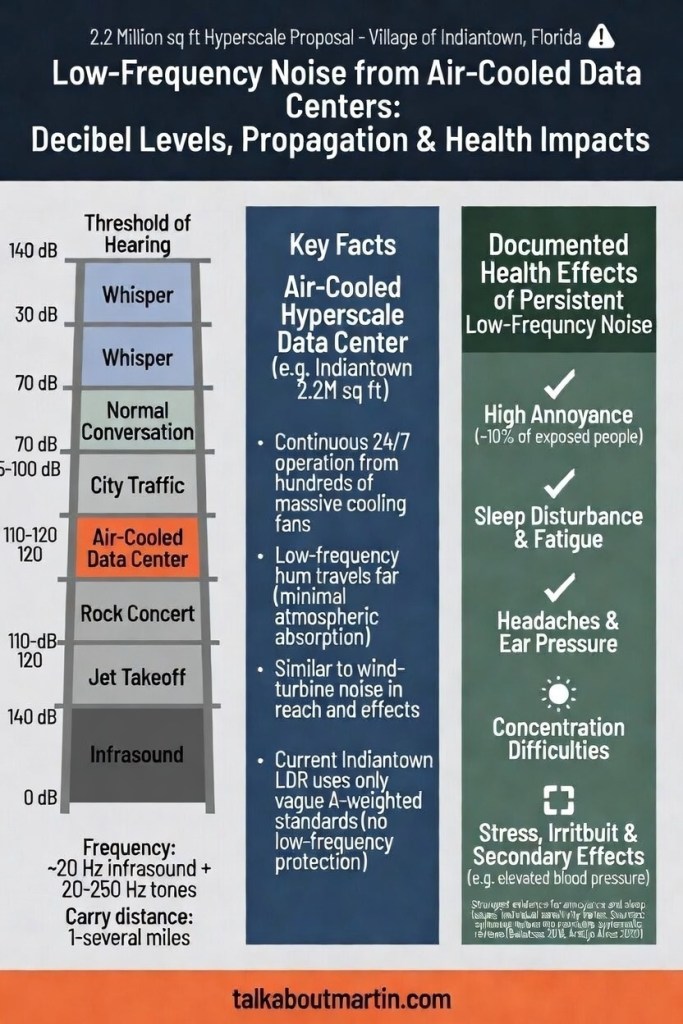
Decibel Chart & Propagation (synthesized from acoustic studies and attached infographic at talkaboutmartin.com):
- Near-source: 85–110+ dB overall
- Frequency range: Strong low-frequency dominant (incl. infrasound <20 Hz + tones 20–250 Hz from blade-pass/fan hum)
- Carry distance: 1 to several miles (low-frequency energy experiences almost zero atmospheric absorption and travels far like wind-turbine noise)
This is directly comparable to wind-turbine blade harmonics, which have caused widespread community complaints of detectable hum miles away. The persistent hum can cause documented health effects including:
- High annoyance (~10% of exposed populations)
- Sleep disturbance & fatigue
- Headaches & ear pressure
- Concentration difficulties
- Stress, irritability & secondary effects (e.g., elevated blood pressure from chronic annoyance)
These effects are well-established in systematic reviews (Baliatsas et al. 2016; Araújo Alves et al. 2020) and are the primary concern for low-frequency noise sources. Low-frequency sound is perceived not only by our ears but by our entire body, triggering physiological and psychological responses. Prolonged exposure can negatively impact concentration, memory, emotional state (anxiety, irritability, mood swings), and create a vicious cycle of sleep disturbances.
In a 2020 meta-review of low-frequency sound health research: “the main effects on human health (of exposure to low-frequency noise) are more prevalent in aspects such as sleep disorders (11.7%), discomfort, sensitivity and irritability to noise (10%), annoyance (13.3%), stress (6.7%), hearing loss (8.3%), reduced performance/fatigue (5%), heart rate/cardiovascular diseases (10%), tension and blood pressure (6.7%), anxiety (1.7%), depression (3.3%), imbalance (3.3%), and mental performance (6.7%).”
Indiantown’s current LDR uses only vague “objectionable to the normal senses” language and A-weighted measurements at the property line. This completely fails to address far-field low-frequency and infrasound propagation that will affect residents 0.5–2.5+ miles away. The code has no quantitative limits, no low-frequency provisions, and no requirement for community monitoring. Even if the developer claims “acceptable” levels at the fence line, the persistent hum will still dominate the soundscape for miles — exactly as our decibel chart demonstrates.
Air pollution, water usage (if any hybrid elements are added), and wildlife impacts are also concerns, but the continuous low-frequency noise is the most pervasive and hardest-to-mitigate issue.
The Village must assess and ensure minimal impacts in all four categories before any approval.
CONCLUSION
The Village should deny the approval of the Silver Fox 606 AI Data Center as currently proposed. The Village should enforce the standards in its comprehensive plan and regulations and deny development for an AI Data Center that fails to meet those standards. I have attached the detailed decibel chart and health impacts infographic (available at talkaboutmartin.com) for your immediate review.
I thank you for your consideration and stand ready to provide additional information or answer questions.
Sincerely, Eric D. Miller
REFERENCES
- WPTV News – “Who’s behind the massive data center planned for Indiantown?” https://www.wptv.com/news/region-martin-county/indiantown/whos-behind-the-massive-data-center-planned-for-indiantown
- Treasure Coast Newspapers (TCPalm) – “2 million-square-foot data center proposed for Florida village” https://www.tcpalm.com/story/news/local/martin-county/2026/01/30/huge-data-center-might-be-coming-to-indiantown/88398722007
- WFLX News – “Proposed data center in Indiantown would impact wetlands and protected species” https://www.wflx.com/2026/03/03/proposed-data-center-indiantown-would-impact-wetlands-protected-species-records-show
- CBS12 News – “The Treasure Coast could gain the state’s first AI data center” https://cbs12.com/news/local/ai-data-center-treasure-coast-undeveloped-land-indiantown-florida-power-light-florida-news
- Village of Indiantown Official Site – Land Development Regulations (Adopted 2020) https://www.indiantownfl.gov/planning-development/page/land-development-regulations-adopted-2020
- Municode Library – Village of Indiantown Land Development Regulations https://library.municode.com/fl/indiantown/codes/charter,_comprehensive_plan_and_land_development_regulations
- Municode Library – Martin County Noise Control Ordinance (fallback applicability) https://library.municode.com/fl/martin_county/codes/code_of_ordinances?nodeId=COOR_CH67ENCO_ART10NO
- TechTarget – “Understanding the impact of data center noise pollution” https://www.techtarget.com/searchdatacenter/tip/Understanding-the-impact-of-data-center-noise-pollution
- Data Center Knowledge – “What are the 5 Main Causes of Noise in Data Centers?” https://www.datacenterknowledge.com/data-storage/what-are-the-5-main-causes-of-noise-in-data-centers-
- Larson Davis – “Data Center Noise Monitoring” https://www.larsondavis.com/applications/environmental-noise-monitoring/data-center-noise-monitoring
- Sierra Club Ohio – “Data Centers & Noise Pollution: Ohio Communities Are Organizing” https://www.sierraclub.org/ohio/blog/2026/02/data-centers-noise-pollution-ohio-communities-are-organizing-accountability
- BBC News – “A humming annoyance or jobs boom? Life next to 199 data centres” https://www.bbc.com/news/articles/c93dnnxewdvo
- Baliatsas et al. (2016) – Systematic review on low-frequency noise and health effects (Referenced in multiple environmental health studies)
- Araújo Alves et al. (2020) – Meta-review of low-frequency noise health impacts (European research on annoyance, sleep, stress, etc.)
- WHO Environmental Noise Guidelines & related low-frequency noise literature (Flag low-frequency components as amplifying adverse effects)
 Talk About Martin
3 thoughts on “Here is an expanded reason why we do not support the projects”