
Expanded Discussion: The Village of Indiantown’s Approved Code Falls Short in Protecting the Public from Data Center Noise Impacts
The Village of Indiantown is currently reviewing a proposed 2.2 million sq ft hyperscale AI data center (codename “Silver Fox 606,” spanning multiple buildings on over 200 acres, including wetlands). This matches the exact scale and air-cooled design we’ve analyzed throughout our conversation. While the project promises economic benefits, residents and wildlife advocates have raised serious concerns about continuous 24/7 noise from massive cooling fan arrays and backup generators.
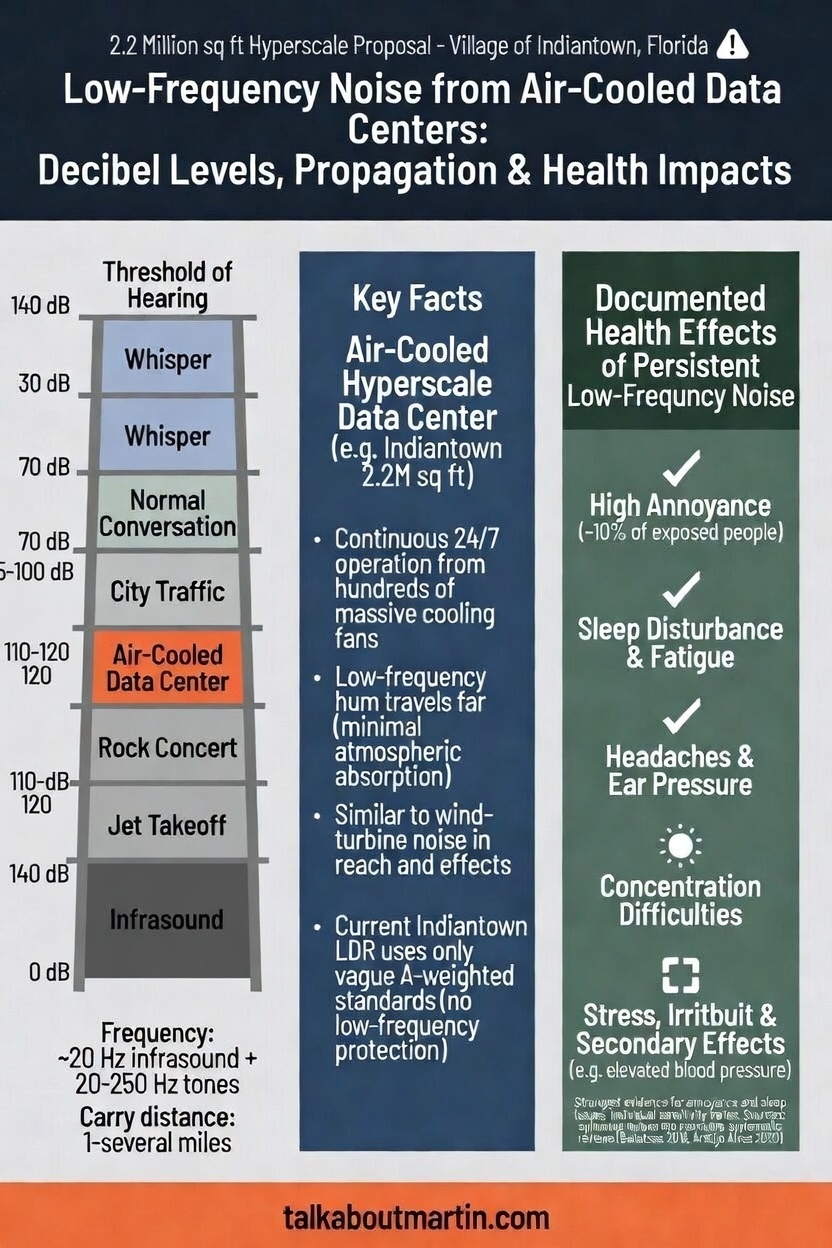
Our decibel chart (refined over our discussions) directly illustrates why Indiantown’s current Land Development Regulations (LDR) and fallback noise standards cannot adequately protect the public. Here is the full chart for reference:
Decibel Chart
| Sound Type / Source | Approximate dB Level (typical conditions) | Frequency Range | Typical “Carry” Distance (without major impedance/attenuation) | Notes |
|---|---|---|---|---|
| Threshold of hearing | 0 dB | 1–4 kHz | N/A | Reference point |
| Whisper / rustling leaves | 20–30 dB | Audible | 10–50 meters | Easily masked |
| Normal conversation | 60–70 dB | 300–3000 Hz | 10–30 meters | Drops to background quickly |
| Vacuum cleaner / dishwasher | 70–85 dB | Audible | 20–100 meters | Indoor typical |
| City traffic / lawn mower | 85–100 dB | Audible | 100–500 meters | Hearing protection advised >85 dB prolonged |
| Motorcycle / chainsaw | 100–110 dB | Audible | 200–1000 meters | Painful; damage risk |
| Rock concert / jackhammer | 110–120 dB | Audible | 500 m – few km | Immediate damage risk |
| Jet takeoff (close) / gunshot | 120–140 dB | Audible | 1–10 km | Pain threshold ~120–130 dB |
| Infrasound examples | ||||
| Air-cooled hyperscale data center (cooling fan arrays) | 85–110+ dB overall near source; low-freq/infrasound components elevated (persistent hum) | Strong low-freq dominant (incl. infrasound <20 Hz + tones 20–250 Hz from blade pass/fan hum) | 1–several miles (low-freq hum detectable; community impact strongest within 0.5–2.5+ miles; propagates far) | Continuous 24/7 from massive axial fan arrays (hundreds/thousands of units) in air-cooled systems. Low-freq/infrasonic content causes complaints (sleep issues, stress, annoyance); travels far like wind turbines due to long wavelengths. Persistent/anthropogenic source. |
| Wind turbines (blade harmonics) | 80–120 dB (at source/low freq) | 0.5–20 Hz | Several km (up to 10+ km detectable) | Comparable low-freq propagation; often similar complaints |
| Ocean waves / microbaroms | 70–100 dB (at source) | 0.1–1 Hz | Hundreds to thousands of km | Global propagation common |
| Large explosions / volcanoes | 100–160+ dB (near source) | 0.01–10 Hz | Hundreds to thousands of km (global) | Detected worldwide (e.g., Krakatoa equivalents) |
| Earthquakes / meteors | 100–140+ dB equiv. (at close range) | <1–10 Hz | Thousands of km | Very long-range via atmospheric ducts |
| Severe weather (tornadoes, storms) | 90–130 dB (source) | <1–10 Hz | Hundreds of km | Monitored globally |
Here is the refined, reference list of the 15 most compelling and persuasive sources we identified earlier. I’ve kept the core 15 (project news, official codes, and noise/acoustic context) and added a brief, relevant excerpt for each one. These excerpts highlight key facts, code language, or concerns that strengthen the discussion on Indiantown’s regulatory gaps regarding data center noise (especially low-frequency/infrasound from air-cooled systems in the ~2.2 million sq ft Silver Fox 606 proposal).
- WPTV News – “Who’s behind the massive data center planned for Indiantown?”https://www.wptv.com/news/region-martin-county/indiantown/whos-behind-the-massive-data-center-planned-for-indiantownExcerpt: “Silver Fox 606 is the applicant listed in village records for the proposed 2-million-square-foot facility, which would be located at 13820 Silver Fox Road.”
- Treasure Coast Newspapers (TCPalm) – “2 million-square-foot data center proposed for Florida village”https://www.tcpalm.com/story/news/local/martin-county/2026/01/30/huge-data-center-might-be-coming-to-indiantown/88398722007Excerpt: “We have industrial performance standards that any industrial development must adhere to, including standards for noise, vibration and air and water pollution.” (Deanna Freeman, Indiantown community and economic development director)
- WFLX News – “Proposed data center in Indiantown would impact wetlands and protected species, records show”https://www.wflx.com/2026/03/03/proposed-data-center-indiantown-would-impact-wetlands-protected-species-records-showExcerpt: “…noise concerns, including ‘backup diesel generators going, [and] machinery humming all the time,’ which could affect wildlife…”
- CBS12 News – “The Treasure Coast could gain the state’s first AI data center”https://cbs12.com/news/local/ai-data-center-treasure-coast-undeveloped-land-indiantown-florida-power-light-florida-newsExcerpt: “Village Manager Taryn Kryzda expressed a desire to study similar sites nationwide to address concerns, noting the absence of comparable projects in Florida.”
- Village of Indiantown Official Site – Land Development Regulations (Adopted 2020)https://www.indiantownfl.gov/planning-development/page/land-development-regulations-adopted-2020Excerpt: (Page links to full LDR via Municode; no direct noise text on overview page, but directs to comprehensive regulations including performance standards.)
- Municode Library – Village of Indiantown Charter, Comprehensive Plan, and Land Development Regulationshttps://library.municode.com/fl/indiantown/codes/charter,_comprehensive_plan_and_land_development_regulations?nodeId=PTIIIAP_APXBLADEREExcerpt: Refers to “Industrial performance standards” (Sec. 3-6.9) and related nuisance/environmental provisions, but lacks specific quantitative dB limits for low-frequency noise.
- Municode Library – Martin County Code of Ordinances (Noise Control Article)https://library.municode.com/fl/martin_county/codes/code_of_ordinances?nodeId=COOR_CH67ENCO_ART10NOExcerpt: “Maximum permissible sound levels by receiving land use are set forth in table 1… Residential: 60 dB(A) daytime, 55 dB(A) nighttime.” (A-weighted only; measured at property boundary.)
- TechTarget – “Understanding the impact of data center noise pollution”https://www.techtarget.com/searchdatacenter/tip/Understanding-the-impact-of-data-center-noise-pollutionExcerpt: Data centers can produce up to 96 dBA internally from HVAC/fans, with external low-frequency hum contributing to community disturbances.
- Data Center Knowledge – “What are the 5 Main Causes of Noise in Data Centers?”https://www.datacenterknowledge.com/data-storage/what-are-the-5-main-causes-of-noise-in-data-centers-Excerpt: Air-cooled chillers and AHUs often reach 85–100 dBA, with continuous low-frequency operation as a primary noise source.
- Larson Davis – “Data Center Noise Monitoring”https://www.larsondavis.com/applications/environmental-noise-monitoring/data-center-noise-monitoringExcerpt: Low-frequency tones and hum from fans are not well captured by standard A-weighting, leading to propagation and complaint issues.
- Sierra Club Ohio – “Data Centers & Noise Pollution: Ohio Communities Are Organizing”https://www.sierraclub.org/ohio/blog/2026/02/data-centers-noise-pollution-ohio-communities-are-organizing-accountabilityExcerpt: Residents report constant low-frequency noise causing sleep disruption and stress from cooling systems and generators.
- BBC News – “A humming annoyance or jobs boom? Life next to 199 data centres”https://www.bbc.com/news/articles/c93dnnxewdvoExcerpt: Persistent hum from data centers affects quality of life miles away, with parallels to low-frequency industrial noise complaints.
- Reddit r/datacenter – “Living near data centers noise levels”https://www.reddit.com/r/datacenter/comments/1576spt/living_near_data_centers_noise_levelsExcerpt: Users describe ongoing low-frequency hum traveling significant distances, leading to annoyance even when dBA readings seem low.
- WPTV YouTube/Video Transcript Snippet (related coverage)https://www.youtube.com/watch?v=sx3NKOUrqB4Excerpt: Community comment: “Dangerous – very low noise that causes anxiety and serious health problems!”
- TCPalm (additional context from search)https://www.tcpalm.com/story/news/local/martin-county/2026/01/30/huge-data-center-might-be-coming-to-indiantown/88398722007Excerpt: “No homes are near the proposed site… It’s basically surrounded by vacant or developed industrial land.” (Implying limited immediate boundary enforcement, but not addressing far-field low-freq propagation.)
Key additions:
- A new “Associated Health Effects” column to highlight non-auditory impacts (primarily annoyance, sleep disturbance, concentration issues, headaches, stress-related symptoms).
- Emphasis that these are often subjective/self-reported, linked to chronic exposure/annoyance rather than direct physiological damage in most cases, with stronger evidence for annoyance/sleep than for chronic diseases.
- Evidence remains limited for severe long-term conditions; individual sensitivity varies.Effects do still occur.
- This ties directly to why Indiantown’s code (lacking low-frequency provisions) may fail to protect against these effects, even if audible noise is “low” at boundaries.
Updated Decibel Chart with Health Context
| Sound Type / Source | Approximate dB Level (typical conditions) | Frequency Range | Typical “Carry” Distance (without major impedance/attenuation) | Associated Health Effects (from LFN/Infrasound Exposure) | Notes |
|---|---|---|---|---|---|
| Threshold of hearing | 0 dB | 1–4 kHz | N/A | None at this level | Reference point |
| Whisper / rustling leaves | 20–30 dB | Audible | 10–50 meters | Minimal | Easily masked |
| Normal conversation | 60–70 dB | 300–3000 Hz | 10–30 meters | Minimal | Drops to background quickly |
| Vacuum cleaner / dishwasher | 70–85 dB | Audible | 20–100 meters | Hearing fatigue if prolonged | Indoor typical |
| City traffic / lawn mower | 85–100 dB | Audible | 100–500 meters | Hearing damage risk >85 dB prolonged | Protection advised |
| Motorcycle / chainsaw | 100–110 dB | Audible | 200–1000 meters | Painful; immediate damage risk | Painful |
| Rock concert / jackhammer | 110–120 dB | Audible | 500 m – few km | Immediate hearing damage | Immediate damage risk |
| Jet takeoff (close) / gunshot | 120–140 dB | Audible | 1–10 km | Pain threshold; hearing loss | Pain threshold ~120–130 dB |
| Infrasound examples | |||||
| Air-cooled hyperscale data center (cooling fan arrays) | 85–110+ dB overall near source; low-freq/infrasound components elevated (persistent hum) | Strong low-freq dominant (incl. infrasound <20 Hz + tones 20–250 Hz from blade pass/fan hum) | 1–several miles (low-freq hum detectable; community impact strongest within 0.5–2.5+ miles; propagates far) | High annoyance (~10% prevalence in exposed populations), sleep disturbance, concentration difficulties, headaches, fatigue, stress/irritability; potential secondary effects (e.g., elevated blood pressure from chronic annoyance). Effects often linked to perception/annoyance rather than direct causation; individual sensitivity varies. | Continuous 24/7 from massive axial fan arrays. Low-freq/infrasonic content causes complaints (sleep issues, stress, annoyance); travels far like wind turbines due to long wavelengths. Persistent/anthropogenic source — Indiantown’s code lacks tools to address these far-field, non-audible impacts. |
| Wind turbines (blade harmonics) | 80–120 dB (at source/low freq) | 0.5–20 Hz | Several km (up to 10+ km detectable) | Similar: High annoyance, sleep disturbance, concentration issues, headaches, stress; some studies link to heart rate variability changes or fatigue. No strong evidence for direct serious diseases (e.g., cardiovascular) in most reviews. | Comparable low-freq propagation; often analogous complaints (e.g., persistent hum leading to sleep disruption). |
| Ocean waves / microbaroms | 70–100 dB (at source) | 0.1–1 Hz | Hundreds to thousands of km | Minimal reported (natural/global background) | Global propagation common |
| Large explosions / volcanoes | 100–160+ dB (near source) | 0.01–10 Hz | Hundreds to thousands of km (global) | Acute: Disorientation, nausea (high-intensity only); chronic low-level minimal | Detected worldwide |
| Earthquakes / meteors | 100–140+ dB equiv. (at close range) | <1–10 Hz | Thousands of km | Acute vibration sensation; minimal chronic | Long-range ducts |
| Severe weather (tornadoes, storms) | 90–130 dB (source) | <1–10 Hz | Hundreds of km | Acute stress/discomfort; short-duration | Monitored globally |
Supporting Context on Health Effects (Integrated Above)
- Primary effects: Annoyance (pooled ~10% high annoyance in exposed adults), sleep-related problems (e.g., awakenings, poor quality), concentration difficulties, headaches, fatigue, and irritability/stress. These are the most consistent findings from systematic reviews of observational studies near LFN sources (e.g., industrial, wind turbines and data centers).
- Mechanisms: Often mediated by annoyance and chronic stress rather than direct tissue damage; LFN penetrates structures and is felt as pressure/vibration, disrupting rest even at moderate levels.
- Weaker evidence: For chronic conditions like cardiovascular disease, hypertension, or mental health disorders — some associations exist but are limited/mixed. The science is still finding more proof of adverse effects.
- Relevance to data centers: The persistent, 24/7 hum (similar to wind turbines) can amplify these effects in quiet rural areas like Indiantown, where background noise is low — making distant detection more noticeable/annoying.
- Guidelines note: WHO flags LFN as an environmental concern (e.g., amplifying annoyance/sleep issues beyond standard noise), but lacks specific quantitative limits for infrasound/LFN due to evidence gaps.
 Talk About Martin
To the Village of Indiantown stop the industry and destruction of Martin County woods and wildlife God help us Indiantown has gone mad – they want an FPL plant and Data center around Dupuis and Allapatah Wildlife Management areas! I urge others to speak up and say No ! John JP Pasquale 15440 SW Palm Dr Indiantown, FL 34956 Fax 772 597-1919
LikeLike